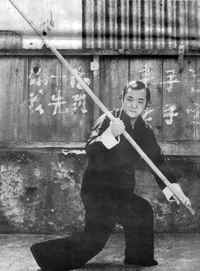
Gene Chen—Chen Jinhong (陳進鴻, Chén Jìnhóng), also romanized Chen Ching Hong—was born in Shanghai in 1938. After living in Hong Kong, he settled in San Francisco in 1959. He began teaching publicly in the early 1970s and later taught at Fort Mason and in Golden Gate Park. He died in San Francisco in 2001.
Gene had practiced several Chinese martial arts before concentrating on Taijiquan. His studies included contact with Yang- and Wu-style teachers, but he became especially committed to investigating the art of Chen Fake, the influential Chen-family master who taught in Beijing.
Archival staff-practice photograph supplied for this page and identified as Gene Chen.
Research and Training in China
Beginning approximately in the early 1970s, Gene made repeated research and training trips through mainland China. These were multiple visits over many years rather than one continuous residence. He sought out surviving members of Chen Fake's family and Beijing teaching circle, comparing their different emphases and methods.
According to the detailed recollections preserved by his student Marin Spivack, Gene's contacts included:
Lei Muni, associated with detailed form instruction
Hong Junsheng, known for mechanical analysis, applications, and push hands
Chen Yuxia, Chen Fake's daughter, particularly associated with sword instruction
Chen Zhaokui, Chen Fake's son
Feng Zhiqiang, who became one of Gene's most important and sustained later teachers
Spivack dates Chen Zhaokui's introduction of Gene to Feng Zhiqiang to approximately 1980. Gene subsequently returned to Beijing for extended periods of private study with Feng throughout the 1980s. The published chronology is incomplete, and many details survive as student oral history rather than through a complete travel diary or institutional archive.
Gene's Place in the Chen Zhaokui Line
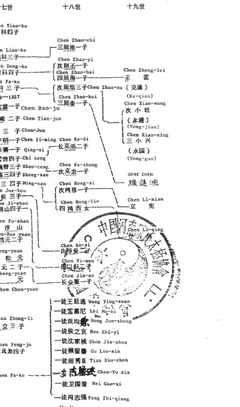
A 1981 Chen-family Taijiquan lineage chart places Gene directly beneath Chen Zhaokui in its nineteenth-generation column, recording Gene within Chen Zhaokui's martial line. This describes martial transmission, not blood descent from the Chen family.
Detail from the 1981 Chen-family Taijiquan lineage chart. The chart places Gene Chen directly beneath Chen Zhaokui in its nineteenth-generation column.
A Distinctive Chen-Family Form
The Yi Lu Gene transmitted was not merely a copy of a single teacher's standardized routine. His students describe it as a distinctive Chen-family transmission incorporating principles and material from several members of the Chen Fake lineage. Gene's additional experience in Yang- and Wu-style Taijiquan also informed his push-hands practice and analysis of martial applications.
For that reason, the form preserved by Henry Wong is most accurately described as Gene Chen's Chen-family Taijiquan Yi Lu. It should not be identified wholesale as Feng Zhiqiang's later Hunyuan curriculum, Hong Junsheng's Practical Method, or a standardized Chenjiagou set, even though Gene learned important material from teachers connected with each of those streams.
Legacy in San Francisco
Gene's influence survives through the students and disciples who trained with him in San Francisco. Henry Wong became Gene's third disciple and continues to cultivate, preserve, and teach the method in Golden Gate Park. Other students have carried aspects of Gene's teaching into their own schools, writings, and oral histories.
Research note: Much of Gene's detailed training history has been preserved by his students, especially Marin Spivack. Approximate dates and descriptions of individual teacher relationships are presented as attributed oral history where independent documentation has not yet been located.